
Annihilated Curse System Explained
How Curses work in Annihilated: earning them from broken items and deaths, spending them on Defy fate, forging gear, and converting leftovers to experience.
Quick answer: Curses are the game's persistent currency. Every shattered item leaves one, and every death adds to the pool. Spend a Curse to Defy fate and erase the worst outcome, forge stored Curses into needed items, or let the leftovers convert into experience at the end of a run.
Curses are the only thing in Annihilated that turns failure into progress. Items break, floors kill you, partners carry trauma, and the Curse pool keeps growing. Understanding that economy is the difference between a run that spirals and a run that gets stronger every time it loses.
Where do Curses come from?
Two sources are confirmed by the store:
- Shattered items. Every item that breaks leaves a Curse. This includes weapons you spend down to zero uses and items destroyed by effects.
- Death. Retrying from the floor where you fell feeds the same pool. The store's line is that every death makes the next run stronger.
That makes breaking weapons less painful than it first appears. The weapon is gone, but its value does not vanish; it becomes the resource that saves the next attempt. The worst runs are the ones where you hoard weapons, never break anything, and arrive at a boss with a full pack and no Curse buffer.
What does Defy fate actually do?
Defy fate cancels the worst possible result of a roll. The store's example is exact: if you roll the worst result, spend a Curse and it never happened. In practice that means:
- A lethal hit on your last living partner can be erased.
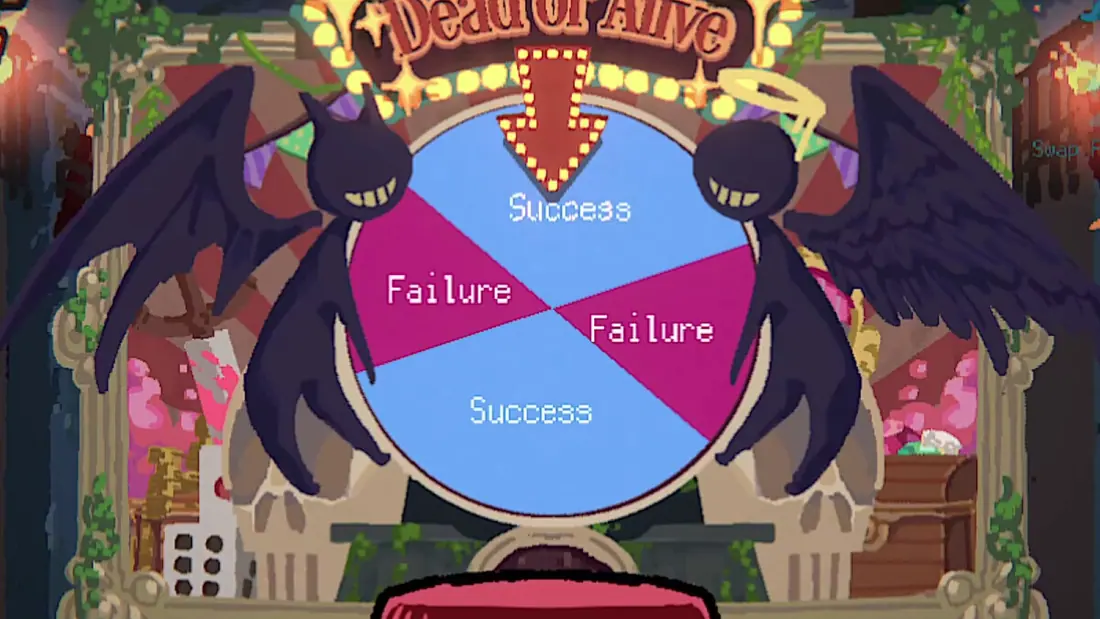
- A catastrophic Dead or Alive spin can be rerolled out of existence.
- A failed timing input that would waste a finisher can be undone.
It does not heal you, reset the enemy's turn, or refill a weapon. It erases one outcome. If three things go wrong in a round, the Curse buys you one of them.
The correct mental model is insurance, not a dodge button. You pay when the alternative is losing the floor's progress, not when a turn is merely inconvenient.
When should you forge instead of Defy fate?
Forging turns stored Curses into the item you need. That is recovery, and recovery is usually worth more than a single save.
Forge when:
- Your last healing card broke and the next floor has no safe heal.
- You have no weapon that can seize equipment before a boss.
- Your deck has a hole that one specific item fills.
Do not forge when:
- You are one Curse away from a Defy fate buffer before a boss.
- The item you want is a comfort pick you can live without.
- You are about to convert everything to experience anyway.
The trade-off is intentionally uncomfortable. A forged item is permanent value; a Defy fate is a one-time save. Both are correct in different runs, which is why the system rewards planning rather than a fixed rule.
How does the experience conversion work?
Stored Curses that you do not spend are converted into experience. The store describes the leftover Curses becoming experience, which means unused insurance is not wasted; it becomes progression.
That creates a useful end-of-run decision. If a floor is stable and you are close to a level or an unlock, stop spending and let the pool convert. If the next fight is a wall, spend freely and accept the smaller conversion.
Is breaking items always correct?
No, but it is correct more often than new players expect. The weapon is strongest on its last use, the break triggers destruction effects, and the break leaves a Curse. Three payoffs stack on the same action.
The exceptions are utility cards. A Hook Rope or a Stiletto may be worth keeping for a specific interaction even at low damage. A Potion is worth keeping until you actually need the heal. The rule is about weapons, not about every item in the pack.
How do Curses interact with the Dead or Alive wheel?
The wheel is where Curses are most visible. Its sectors split between success and failure, and a bad spin is exactly the kind of "worst possible result" that Defy fate exists to erase.
If you play probability style, budget at least one Curse per boss for a catastrophic spin. If you play timing style, the same budget goes toward a fumbled finisher or a lethal telegraph you misread.
One is for the run-ending mistake. The second is for the mistake you make while recovering from the first.
Official source: Annihilated on Steam ↗
Does the Curse system punish hoarding?
Yes, but quietly. A hoarded weapon never generates a Curse, never triggers its destruction effect, and never frees the slot for stolen gear. The pack fills with unused potential while the Curse pool stays empty.
The game's intended loop is break, steal, break again. Each cycle converts a weapon into a kill, a piece of enemy gear, and a Curse. A player who refuses to break anything is playing the same game with the rewards switched off.
How should a first run spend its first ten Curses?
A simple allocation:
- Two held as a boss buffer.
- Three forged into healing or a seize-capable weapon.
- Five allowed to convert into experience.
Adjust after the first boss. If you died to a damage check, forge a finisher. If you died to a bad spin, hold more Defy fate. If you never spent a Curse, you were over-insured and can convert more aggressively.
Curses only matter because death is persistent; the death and progression guide→ explains the loop, and the weapon guide→ covers destruction effects.
FAQ
Do Curses carry between runs?
Stored Curses are the persistent layer described by the store. They survive death and can be forged or converted, which is what makes a failed run still count.
Can you buy Curses?
No shop is mentioned. Curses come from broken items and death, which keeps the economy tied to risk rather than currency.
Is Defy fate random?
No. It cancels an outcome you choose to reject. The randomness is in what happened, not in whether the Curse works.
Should you break the starting weapon?
Usually yes, once it has one use left and you have a replacement lined up. The starting Iron Sword exists to teach the break loop.