
Annihilated Death Progression Guide
What happens when you die in Annihilated, what a retry keeps, how Curses make every failure count, and how to turn a wipe into a stronger next attempt.
Quick answer: Death in Annihilated sends you back to the floor where you fell, not to the start of the game. Stored Curses survive, leftover Curses become experience, and the game is explicit that every death makes the next attempt stronger. The cost is time, not story progress.
Annihilated is a roguelite in structure and a horror story in tone. The dungeon wants you to feel that the party is not coming back whole. The systems, though, are built to keep you moving: the floor checkpoints the retry, the Curse pool banks the failure, and the route's story flags do not reset.
What exactly happens when you die?
You retry from the floor where you fell. The store states this directly. That is a softer reset than a full roguelike run: you are not sent to the entrance, and you are not asked to replay the story from the title screen.
The retry is a combat reset, not a narrative one. The floor's encounters, the boss, and your deck state are the variables. Your route choice and the story beats you have seen are not.
The store does not itemize what happens to every carried item after a wipe. The safe assumption is that the attempt's consumed resources stay consumed: broken weapons were broken, spent heals were spent. That is why the Curse pool matters so much. It is the part of the failure that is guaranteed to come back with you.
What persists across deaths?
Three things are confirmed:
- Stored Curses. They are described as persisting beyond death, and they are the resource you forge or convert.
- Conversion progress. Leftover Curses become experience, which means a run that ends badly still pays out.
- Knowledge. Telegraphs, boss patterns and break thresholds are player knowledge, and the game does not hide them.
That combination is why the community calls the structure roguelite rather than roguelike. The meta layer is the Curse economy, not a new character or a new weapon pool.
How does a death make the next run stronger?
The phrase on the store page is literal in the systems sense. A death adds to the Curse pool. The pool either becomes insurance for the next attempt or experience for the long-term curve. Either way, the next attempt starts with more than the last one did.
The weaker part is your inventory. If you died because you had no finisher, the Curse pool does not automatically give you one; you have to forge it. That is the decision point the game wants you to make: convert the failure into safety or into progress.
Should you retry the same floor immediately?
Usually yes, with one change. The fastest way to learn a boss is to repeat it until the telegraphs are boring. The fastest way to hate the game is to repeat it with the same deck and the same opening.
Change one variable per attempt:
- Swap the finisher for a higher-stagger weapon.
- Move the heal earlier in the turn order.
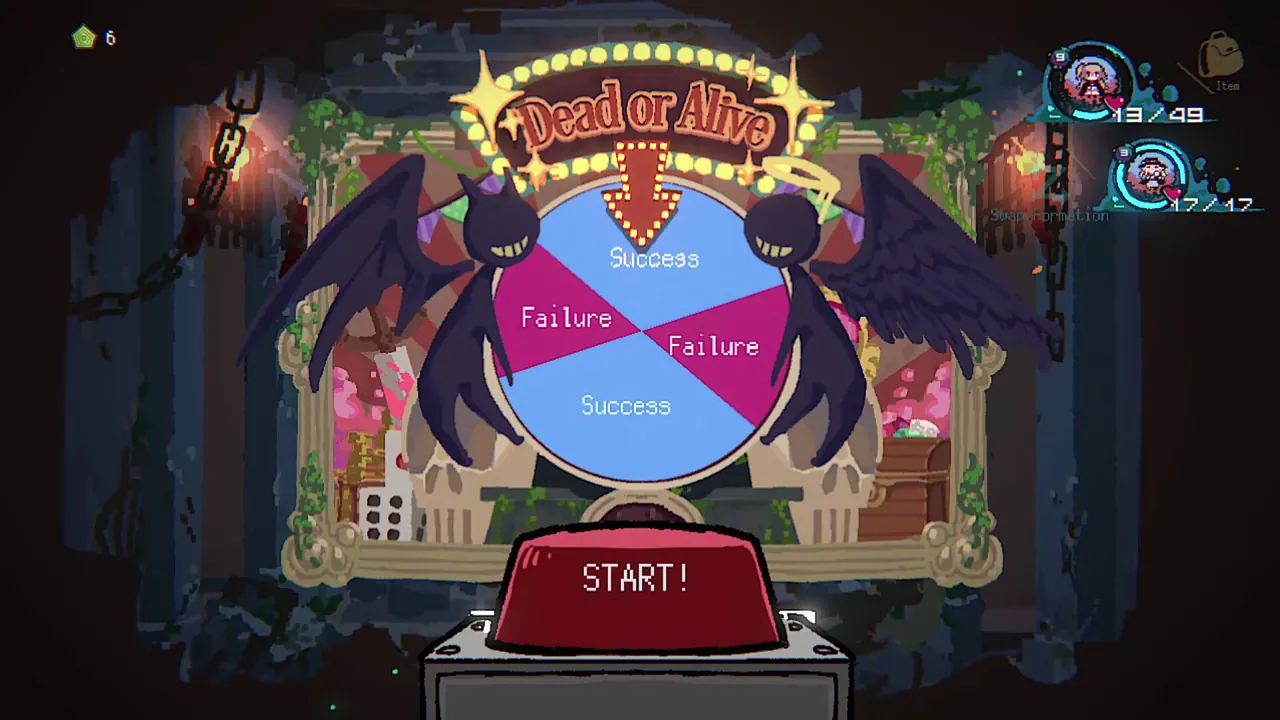
- Spend one Curse on the spin instead of saving it.
- Take the safe attack instead of the greedy one on the telegraph turn.
Four attempts with four changes teach more than ten attempts with none.
When should you stop retrying and restart the route?
Almost never. The route is roughly six hours, and the retry point is the floor where you fell. Restarting throws away the story progress you have already paid for.
The exceptions are build-level mistakes. If you arrive at a boss with no healing, no seize-capable weapon and no Curses, the floor may be mathematically unwinnable. Even then, check whether a forge can fix the deck before you restart. Restarting is the last option, not the brave one.
How does the difficulty curve feel?
The opening is a tutorial in disguise. Goblins and Kobolds teach the telegraph, the first boss teaches stagger, and the route split teaches commitment. The middle of a route is where the card economy starts to bite: heals run dry, weapons break faster than you can steal replacements, and Curses become a budget rather than a bonus.
The end of a route is a resource exam. You will not have every item you want. The question is whether the items you have can produce one clean break and one clean finisher.
A restart costs six hours of route content. A retry costs one floor. If you are stuck, change the deck before you change the save.
Official source: Annihilated on Steam ↗
Is Annihilated a roguelike or an RPG?
It is a turn-based RPG with roguelite progression. The store tags it both Roguelite and Roguelike, alongside JRPG and Story Rich. The distinction matters for expectations:
- The story is fixed and authored, not procedurally generated.
- The routes are hand-written and roughly six hours each.
- The run layer is the card inventory, the break economy and the Curse pool.
- Death checkpoints at the floor rather than resetting the campaign.
If you want a pure roguelike with random runs, this is not that. If you want a story RPG where failure has a mechanical cost and a mechanical refund, this is exactly that.
How should you plan a session?
Plan around bosses, not floors. A session that ends mid-floor is fine; a session that ends mid-boss wastes the setup. Before you stop playing, spend the Curses you are carrying. An unspent pool at the end of a session is a decision deferred, and deferred decisions pile up.
If you have 30 minutes, farm a safe floor for a weapon to break. If you have two hours, push toward the next boss and commit the Curses.
The Curse system→ is the other half of the retry loop, and the walkthrough→ shows where each floor's risk spikes.
FAQ
Do you lose story progress when you die?
No. The retry starts at the floor where you fell, so the route's story progress is preserved.
Are deaths permanent in Annihilated?
No. Death is a retry checkpoint, and it feeds the Curse economy.
Does the game get easier the more you die?
The Curse pool grows and converts into experience, so the long-term curve bends in your favor. Individual fights still depend on the deck you bring.
Can you change partners after a death?
The partner choice is a route decision, not a retry option. Changing it means a new run.